Try searching for something else or browse our categories.
How-To GuidesIgnition System
What Does an Ignition Coil Do? (How It Works in Your Toyota)
Learn exactly what a Toyota ignition coil does — transforming 12V into the tens of thousands of volts needed to fire every spark plug, via electromagnetic induction.
Craig Sandeman
Automotive industry researcher and content specialist at Used Toyota Parts SA.
An ignition coil converts your Toyota's 12-volt battery supply into the tens of thousands of volts needed to fire each spark plug. Most modern Toyotas use a dedicated coil-on-plug unit per cylinder; diesel models don't use ignition coils at all.
Key Takeaways
Your Toyota's engine fires hundreds of sparks every minute — but the 12-volt battery that starts the car can't generate a spark powerful enough to ignite compressed fuel. That's the ignition coil's job: it transforms weak battery current into a high-voltage pulse of tens of thousands of volts (around 20,000 volts in DENSO's worked example) that bridges the spark plug gap and sets the combustion process in motion.
On most modern Toyotas — Corolla, Yaris, Camry, Fortuner, and the petrol Hilux — each cylinder has its own dedicated coil-on-plug unit sitting directly on top of the spark plug. When one fails, you feel it immediately: a misfire, rough idle, and a flashing check engine light. Understanding how the coil works helps you recognise problems early and make smarter parts decisions.
Key Takeaways
Question
Answer
What does an ignition coil do?
Transforms 12V battery current into tens of thousands of volts to fire spark plugs
How does it work?
Electromagnetic induction: primary winding builds a magnetic field; when cut, the collapsing field induces high voltage in the secondary winding
Primary winding turns
Approximately 150–300 turns of thick wire
Secondary winding turns
Approximately 15,000–30,000 turns (roughly 100× more than primary)
3-cylinder Toyota (e.g. Yaris 1.0)
3 coils — one per cylinder in coil-on-plug systems
4-cylinder Toyota (e.g. Corolla, Yaris 1.3/1.5)
4 coils — one per cylinder in coil-on-plug systems
V6 Toyota (e.g. Fortuner 4.0, Land Cruiser 4.0)
6 coils — one per cylinder
Diesel Toyotas (Hilux GD6, Prado diesel)
No ignition coils — diesel uses compression ignition, not sparks
Older Toyotas (e.g. Tazz 1.3 with 2E engine)
Single distributor coil shared across all cylinders
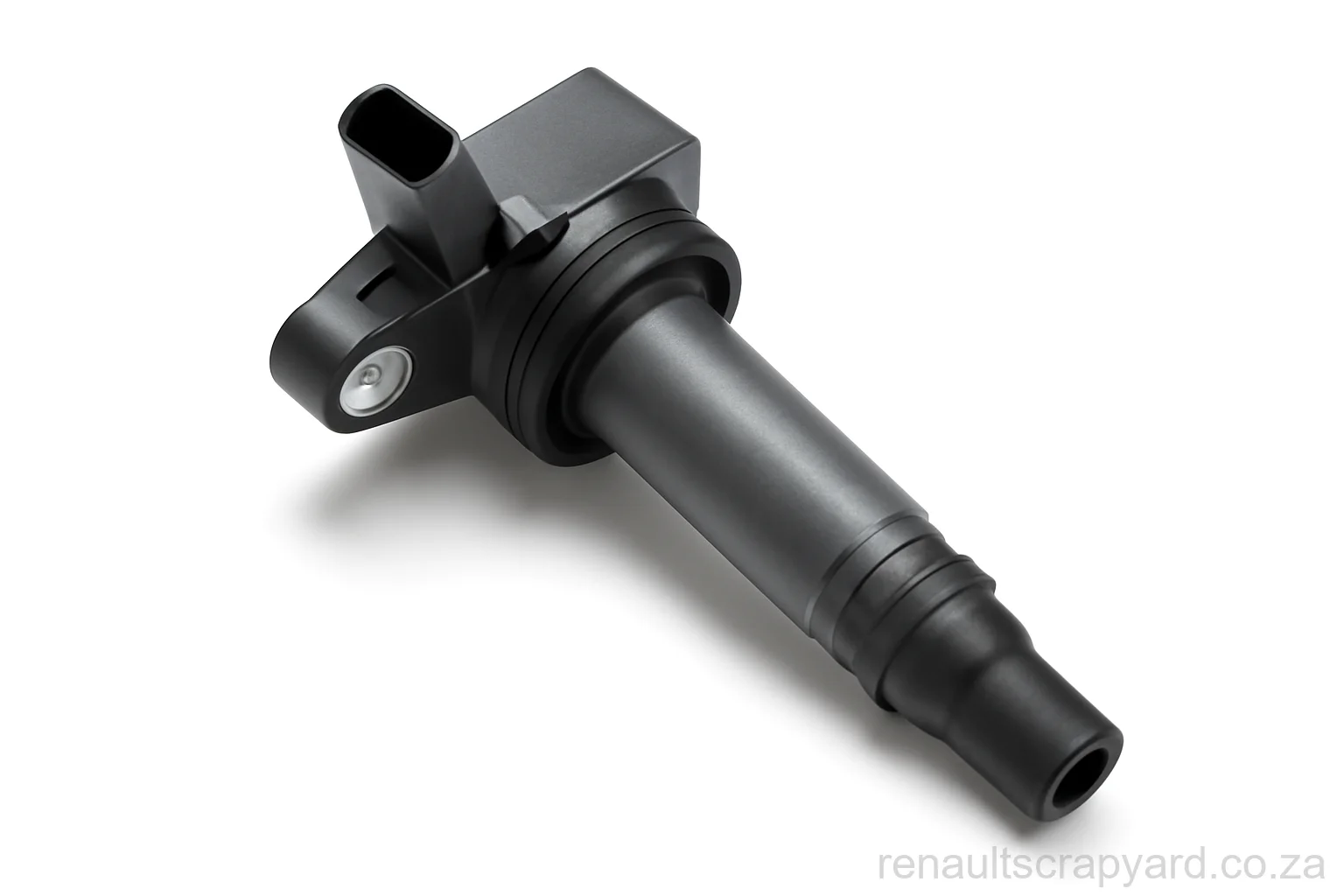
Toyota Ignition Coil
New & quality used stock from our Johannesburg & Cape Town branches — delivered nationwide.
The Science Behind the Spark: How an Ignition Coil Works
An ignition coil is essentially a miniature electrical transformer. It applies a principle discovered by Michael Faraday in 1831: a changing magnetic field induces voltage in a nearby coil of wire. The greater the rate of change in the magnetic flux, and the more turns of wire in the secondary coil, the higher the induced voltage.
Inside every ignition coil there are two separate windings wrapped around an iron core:
Primary winding: Approximately 150–300 turns of relatively thick wire, connected to the battery through the engine control unit (ECU). This carries the low-voltage input current.
Secondary winding: Approximately 15,000–30,000 turns of much finer wire — roughly 100 times more turns than the primary. This is where the high voltage is generated.
Here's what happens in microseconds when the ECU commands a spark:
The ECU switches the primary circuit ON. Current from the 12V battery flows through the primary winding, building a strong magnetic field around the iron core.
At the precise moment a spark is needed, the ECU switches the primary circuit OFF. The magnetic field collapses almost instantly.
That collapsing field cuts through the thousands of turns of the secondary winding, inducing a voltage surge of tens of thousands of volts, depending on the engine and operating conditions.
This high-voltage pulse travels to the spark plug, jumps the electrode gap, and ignites the compressed air-fuel mixture in the cylinder.
Why so many turns? The voltage ratio between secondary and primary is proportional to the ratio of winding turns. With roughly 100 times more turns in the secondary, a 200-volt pulse in the primary can become approximately 20,000 volts in the secondary — more than enough to fire a spark plug under engine compression.
Three Types of Ignition Coil Systems
Toyota has used three distinct ignition architectures over the decades. Knowing which one your vehicle has matters for diagnosis and parts sourcing.
1. Distributor Coil (Single Coil)
Used on older Toyotas — including the Tazz 1.3 with its 2E engine — a single coil serves all cylinders. The high-voltage output goes to a distributor, which rotates mechanically and routes the spark to each plug in the correct firing order. Simple and low-cost, but the distributor cap and rotor wear over time and spark timing is mechanically limited.
2. Wasted-Spark (Coil Pack) Systems
An intermediate design where one coil fires two cylinders simultaneously by pairing cylinders on opposite strokes. One cylinder receives a useful spark under compression; its paired cylinder fires during the exhaust stroke (harmless). This design eliminates the distributor while using fewer coils than a full coil-on-plug setup.
3. Coil-On-Plug (COP) — The Modern Standard
Most Toyotas sold in South Africa from the early 2000s onwards use coil-on-plug ignition: one dedicated coil sits directly on each spark plug, eliminating high-tension leads entirely. The ECU fires each coil independently, giving precise timing control for every cylinder.
COP counts by engine type: A 3-cylinder Toyota (Yaris 1.0) has 3 coils. A 4-cylinder Toyota (Corolla 1.6/1.8, Yaris 1.3/1.5, petrol Hilux 2.7) has 4 coils. A V6 Toyota (Fortuner 4.0, Land Cruiser Prado 4.0) has 6 coils. If one COP coil fails, only that cylinder misfires — you can swap coils between cylinders to identify the faulty unit quickly.
Petrol vs Diesel: Which Toyotas Have Ignition Coils?
Diesel Toyotas do not use ignition coils. Diesel engines — including the Hilux 2.4 and 2.8 GD6, the Land Cruiser 200 V8 diesel, and the Fortuner and Quantum diesel variants — ignite fuel by compression alone. No spark plug, no ignition coil. If you drive a diesel Toyota and a workshop quotes ignition coils, question it.
Ignition coils are only relevant to petrol-engined Toyotas. Here's a quick reference for common SA models:
Toyota Model (SA)
Engine
Ignition Type
Coils Needed
Tazz 1.3
2E
Distributor (single coil)
1
Corolla 1.6 / 1.8 (2001+)
3ZZ-FE / 1ZZ-FE
Coil-on-plug
4
Yaris 1.0 (3-cyl)
1KR-FE
Coil-on-plug
3
Yaris 1.3 / 1.5 (4-cyl)
2NZ-FE / 1NZ-FE
Coil-on-plug
4
Camry 2.4
2AZ-FE
Coil-on-plug
4
Hilux 2.7 Petrol
2TR-FE
Coil-on-plug
4
Fortuner / Hilux 4.0 V6
1GR-FE
Coil-on-plug
6
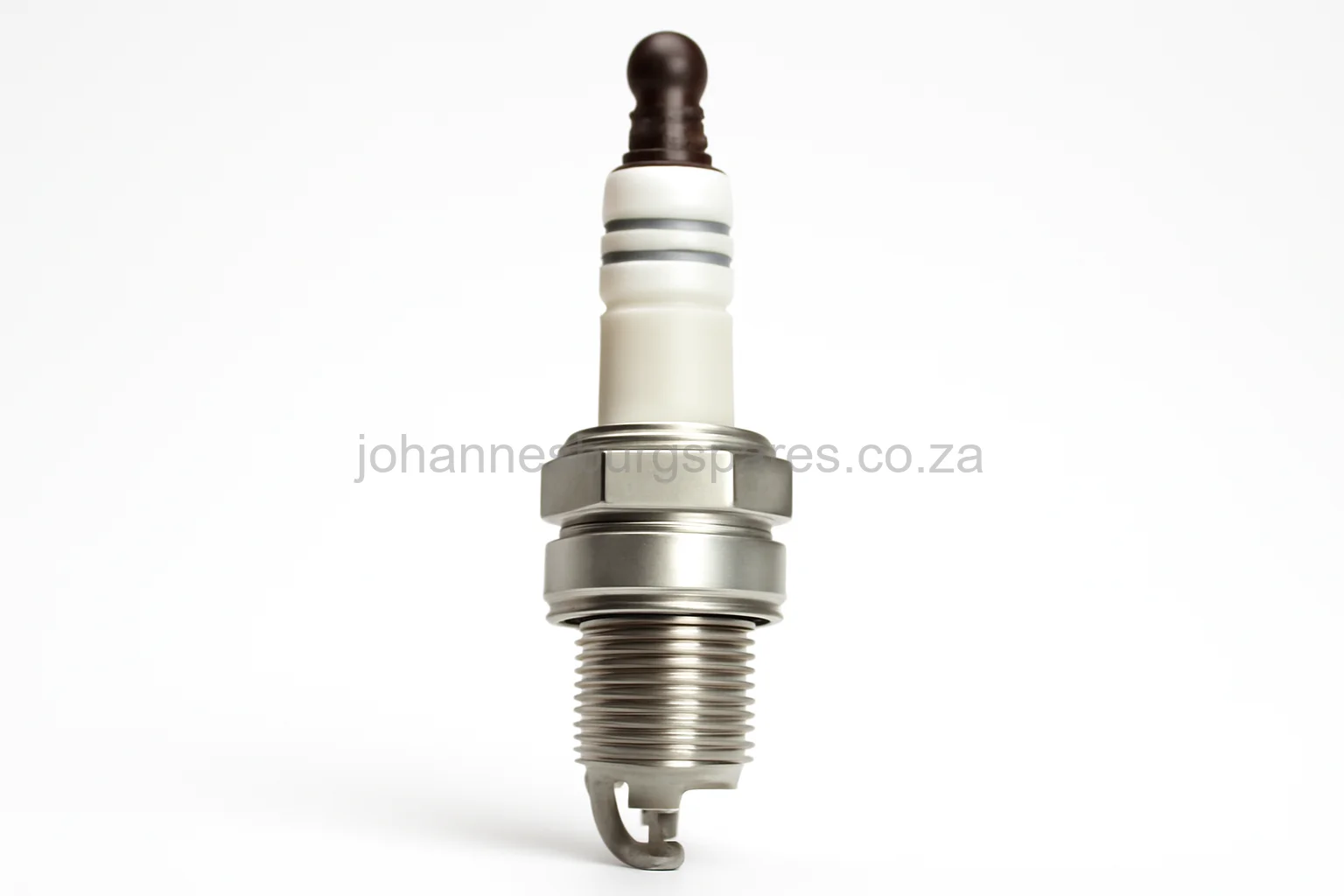
Toyota Spark Plugs
New & quality used stock from our Johannesburg & Cape Town branches — delivered nationwide.
How the ECU Controls the Ignition Coil
In a modern Toyota with coil-on-plug ignition, the engine control unit (ECU) manages every aspect of spark timing. It reads data from the crankshaft position sensor, camshaft position sensor, mass airflow sensor, throttle position sensor, and engine temperature sensor — then calculates exactly when to fire each coil.
The ECU sends a low-current switching signal to each coil's built-in transistor or igniter. This transistor switches the primary winding on and off at precisely the right moment. The result is spark timing accurate to fractions of a degree — far beyond what a mechanical distributor could achieve.
Spark frequency — At 3,000 rpm, each cylinder in a 4-cylinder engine fires 25 times per second. Each ignition coil must charge and discharge reliably thousands of times per minute, every minute the engine runs.
What Happens When an Ignition Coil Fails?
A failed or weak coil can't generate enough voltage to fire the spark plug reliably. The consequences build quickly:
Engine misfire — The affected cylinder stops contributing power; you feel a stumble or vibration, especially under load or at idle
Check engine light (P030x codes) — The ECU logs a misfire code. P0300 indicates a random misfire; P0301, P0302, P0303, P0304 pinpoint specific cylinders on a 4-cylinder engine
Increased fuel consumption — Unburnt fuel is wasted and can contaminate engine oil
Catalytic converter damage — Raw fuel entering the exhaust overheats the catalytic converter, potentially destroying it — a costly secondary failure
Hard starting or no-start — Multiple failed coils can prevent the engine starting entirely
Because coil-on-plug systems isolate each coil, a useful field test is to swap the suspect coil with one from a different cylinder. If the misfire code follows the coil to its new position, the coil is faulty. If the code stays on the same cylinder, suspect the spark plug or injector instead.
A Toyota ignition coil is a sealed unit with no serviceable internal parts. There is no fixed lifespan — Toyota does not list coils in its service schedule — and heat, oil contamination from a leaking valve cover gasket, and poor-quality aftermarket coils can shorten a coil's life considerably.
When one coil fails on a high-mileage Toyota, many mechanics recommend replacing all four (or six) at the same time. The remaining coils are the same age and will often fail in quick succession — making a single replacement a false economy. Denso is Toyota's OEM coil supplier; used OEM coils in good condition offer excellent value over budget aftermarket options.
It converts your car's 12-volt battery supply into the high voltage — tens of thousands of volts — needed to jump the spark plug gap and ignite the compressed air-fuel mixture in each cylinder. Without a working coil, there's no spark and the engine won't run.
Is an ignition coil the same as a spark plug?
No. The ignition coil generates the high voltage; the spark plug uses that voltage to create the actual spark inside the combustion chamber. They work as a team — a strong coil can't compensate for a worn spark plug, and vice versa.
How do I know which ignition coil has failed?
Connect an OBD-II scanner to your Toyota's diagnostic port under the dashboard. A P0301 code means cylinder 1 is misfiring, P0302 means cylinder 2, and so on. Then do a physical swap: move the coil from that cylinder to a different one and re-scan. If the misfire code changes cylinder number, the coil is faulty. If it stays on the same cylinder, the spark plug or fuel injector is more likely to blame.
Can a bad ignition coil damage my engine?
Running a misfiring engine for extended periods risks overheating the catalytic converter (raw fuel in the exhaust destroys the catalyst) and can lead to oil dilution from unburnt fuel washing the cylinder walls. Address a misfire code within a few days — don't run your Toyota on a known misfire indefinitely.
Do diesel Toyotas have ignition coils?
No. Diesel engines ignite fuel purely through compression heat — there's no spark plug and no ignition coil in the system. This applies to the Hilux GD6 (2.4 and 2.8), Fortuner diesel, Land Cruiser diesel, and Quantum diesel. If you have a diesel Toyota and are chasing a rough-running issue, look at glow plugs, injectors, or the fuel system instead.
Should I replace all coils at once or just the faulty one?
On a high-mileage Toyota, replacing all coils at the same time is often the smarter move. They're all the same age and usually the same brand; once one starts failing from heat fatigue, the others often follow. Doing them together saves on labour and prevents a second breakdown. On a lower-mileage vehicle, replacing just the faulty coil is fine. Read our guide on ignition coil lifespan and when to replace for more detail.
Related Video
Video: Inside an Ignition Coil (Cut Open & Explained)
This article is for informational and educational purposes only, based on automotive industry research and publicly available data. Used Toyota Parts SA is a parts supplier, not a licensed automotive repair facility. We do not provide mechanical advice or diagnostics.
Always consult a qualified mechanic or Toyota-certified technician before performing repairs. Incorrect installation of parts can lead to vehicle damage, safety hazards, or injury. Prices, specifications, and availability mentioned are approximate and subject to change.
We assume no liability for actions taken based on this content. Contact us for current parts availability and pricing.
Need Toyota Parts?
Get a free quote from our suppliers. New aftermarket and quality used parts for all 37 Toyota models, delivered nationwide.