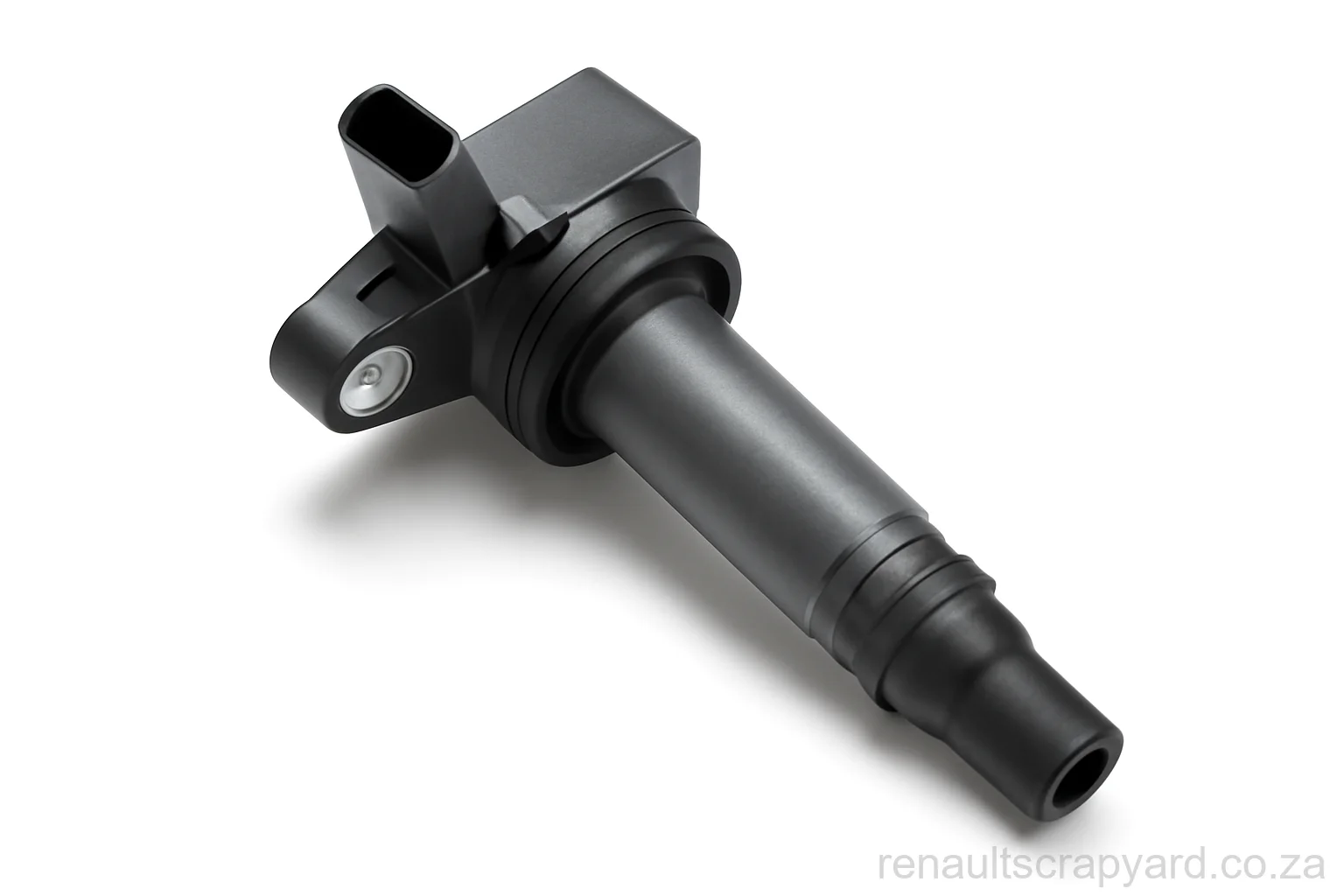
A failing ignition coil typically reveals itself through engine misfires, rough idle, a check engine light (codes P0300–P0306), loss of power, and rising fuel consumption. Catch it early and a repair costs R265–R900 per coil; ignore it and you risk catalytic converter damage costing several times more.
Key Takeaways
A failing ignition coil rarely dies without warning. Most Toyota drivers get days — sometimes weeks — of early symptoms before the coil quits completely. Recognise these 8 warning signs now and you could avoid a tow truck, a missed day at work, and a far bigger repair bill.
The short answer: if your Toyota is misfiring, idling roughly, flashing a check engine light, or drinking more petrol than usual, a failing ignition coil is one of the first things to investigate. Aftermarket replacement coils cost R265–R650 each; genuine Denso units run R700–R900.
Key Takeaways
Symptom
What You Will Notice
OBD Code
Urgency
Check Engine Light
CEL on; scanner shows P0300–P0306
P0300–P0306
Scan immediately
Engine Misfire
Jerking, stuttering, vibration under load
P0301–P0306
High — do coil-swap test
Rough Idle
Shaking at standstill, uneven revs
P0300
Medium — check coils + plugs
Loss of Power
Hesitation pulling away; sluggish on inclines
P0300
Medium
Increased Fuel Consumption
Filling up more often than usual
—
Medium — diagnose soon
Hard Starting
Long cranking especially on cold mornings
—
Medium
Engine Stalling
Cuts out at traffic lights or low revs
P0300
High — repair urgently
Exhaust Backfire
Loud pops from the exhaust pipe
—
High — stop driving
Why Your Toyota's Ignition Coils Matter
Most petrol Toyota Corolla, Yaris, Etios, Hilux, and Fortuner models built since the early 2000s use a coil-on-plug (COP) ignition system — one coil sitting directly on top of each spark plug. That coil steps ordinary 12-volt battery power up to the tens of thousands of volts needed to fire the plug and ignite the air-fuel mixture in the cylinder.
When a coil weakens, its cylinder misfires. One misfiring cylinder on a 4-cylinder engine is 25% of your power gone — and the ECU knows immediately.
V6 engines (Fortuner 4.0, Toyota Hilux 4.0 V6): 6 coils
3-cylinder engines (Agya 1.0): 3 coils
3RZ-FE 2.7i: the ignition changed across its life — the earliest engines (1995–96) used a single-coil distributor, mid-generation units (1997–99) a wasted-spark system with 2 coils (Denso 90919-02217 for cylinders 1 & 4, 90919-02220 for 2 & 3), and later engines (2000–04) moved to 4 individual coil-on-plug coils. Check your build year before ordering.
Good to know: On a COP Toyota, a failing coil affects only the specific cylinder it sits on. An OBD scanner will tell you exactly which cylinder is misfiring — so there is no need to guess.
The 8 Warning Signs of a Bad Ignition Coil
1. Check Engine Light (CEL) Is On
The check engine light is almost always the first electrical indication. The engine control unit (ECU) detects that a cylinder is not firing correctly and logs a fault code. Any OBD-II scanner — sold at motoring stores, and many SA fitment centres will read the codes for you — will show one or more of these:
P0300 — Random or multiple cylinder misfire (ECU can't pin down one cylinder)
P0301 — Cylinder 1 misfire detected
P0302 — Cylinder 2 misfire detected
P0303 — Cylinder 3 misfire detected
P0304 — Cylinder 4 misfire detected
P0305 — Cylinder 5 misfire (V6 engines)
P0306 — Cylinder 6 misfire (V6 engines)
The digit at the end of the code tells you the specific cylinder. If you get P0302, cylinder 2 is the one to investigate first.
Pro tip: Many SA fitment centres and even some petrol stations will scan your OBD port for free or a small fee. A 2-minute scan saves hours of guesswork.
2. Engine Misfires — Stuttering and Juddering
A misfire happens when a cylinder fires at the wrong time, too weakly, or not at all. In your Toyota it feels like:
A jerk or judder when pulling away from a stop
The engine coughing or stumbling during acceleration
A rhythmic vibration that worsens under load — on a hill, when towing, or with a full load of passengers
Misfires are hard on the catalytic converter. Raw unburned fuel enters the exhaust and can overheat and damage the cat substrate. Do not ignore a misfire.
3. Rough Idle and Cabin Vibration
At a stop — in traffic, at a petrol station, waiting at a school — your Toyota should run smoothly and quietly. A failing coil makes the idle lumpy and uneven. You will feel vibration through the seat, the floor, and the steering wheel, and the rev counter may hunt up and down. On a 4-cylinder Corolla or Yaris, one dead coil removes 25% of the engine's firing events; the roughness is very noticeable, even to passengers.
4. Loss of Power and Hesitation Under Acceleration
Press the accelerator and feel nothing — or the car surges and then stutters? This is a classic coil symptom. A weak spark means incomplete combustion, and incomplete combustion means less energy per power stroke. On a Hilux or Fortuner, the power loss can feel like a missing gear — especially noticeable when overtaking, climbing a mountain pass, or driving loaded.
Toyota Ignition Coil
New & quality used stock from our Johannesburg & Cape Town branches — delivered nationwide.
5. Increased Fuel Consumption
Visiting the petrol station more often? This is often the sneaky symptom — Toyota drivers notice the tank empties faster but do not connect it to the ignition system. Here is what is actually happening: when a cylinder misfires, unburned fuel passes through to the exhaust. The ECU detects the lean condition and compensates by injecting more fuel. You spend more money at the pump while the real culprit is a coil that costs a fraction of the extra fuel bill.
Cost of delay: Every week on a failing coil means paying for fuel that never turns into power — before you even count the risk of catalytic converter damage.
6. Hard Starting — Especially on Cold Mornings
Cold mornings are the worst time for a weak ignition coil. Low temperatures thicken engine oil, increasing the load on the starter motor. Meanwhile, a marginal coil that just managed to fire in warm conditions may fail entirely in the cold. If your Toyota cranks longer than usual before starting, particularly on a winter morning on the Highveld, include the ignition coils in your diagnosis alongside the battery and spark plugs.
7. Engine Stalling
As a coil deteriorates further, it may lose spark completely at low revs or under specific conditions — causing the engine to cut out at a traffic light, in slow-moving traffic, or even at speed on the highway. Stalling while driving is dangerous. Treat repeated stalling as an urgent fault and get it diagnosed that day.
Safety warning: If your Toyota stalls on the road, pull over safely and switch on your hazard lights. Do not continue driving with a known coil misfire — sustained misfires can crack the catalytic converter, turning a coil repair of a few hundred rand into a catalytic converter replacement that costs many times more.
8. Backfiring from the Exhaust
A sharp pop or bang from the exhaust — especially when lifting off the accelerator — means unburned fuel is igniting in the exhaust system. While backfiring has several causes, a failed ignition coil is high on the list. The coil fails to fire the plug; raw petrol/air mixture enters the exhaust; exhaust heat ignites it; bang. Stop driving and have it investigated — repeated backfires stress the exhaust manifold, catalytic converter, and rear silencer.
Reading Your Toyota's OBD Codes
An OBD-II scanner is the fastest way to diagnose an ignition coil problem. Here is what the misfire codes mean and what to do next:
Code
Meaning
Next Step
P0300
Random or multiple cylinder misfire — ECU cannot pin down one cylinder
Check all coils and spark plugs; consider coil-swap test on each
P0301
Cylinder 1 misfire detected
Swap coil from cylinder 1 to another; if code moves, replace coil 1
P0302
Cylinder 2 misfire detected
Swap coil 2 to another cylinder
P0303
Cylinder 3 misfire detected
Swap coil 3 to another cylinder
P0304
Cylinder 4 misfire detected
Swap coil 4 to another cylinder
P0305
Cylinder 5 misfire (V6)
Swap coil 5 to another cylinder
P0306
Cylinder 6 misfire (V6)
Swap coil 6 to another cylinder
Remember: worn spark plugs can also trigger misfire codes. If swapping the coil does not move the code to a new cylinder, replace the spark plug on that cylinder next. On high-mileage Toyotas (150 000 km and above), replacing both coils and plugs at the same service saves a second workshop visit when the plugs eventually cause the same symptoms.
The Quick Coil-Swap Test
This is the most reliable way to confirm a faulty coil — no special tools required beyond your OBD scanner:
Scan the OBD port and note which cylinder code appears (e.g. P0302 = cylinder 2).
With the engine cold and off, remove the coil from the suspect cylinder (cylinder 2 in this example).
Swap it with the coil from another cylinder — e.g. move coil 2 to position 3, and coil 3 to position 2.
Clear the fault codes and go for a short drive.
Scan again. If the misfire code has moved from P0302 to P0303, the coil itself is faulty — not the cylinder. Replace it.
If the code stays on P0302, the cylinder has a different problem (injector, plug, compression) — the coil is innocent.
Toyota-specific note: All COP coils on the same 4-cylinder engine are identical and interchangeable for this test. On the 1GR-FE 4.0 V6 (Fortuner, Prado, Hilux V6) all six positions take the same coil (OE 90919-02248), so the swap test works the same way.
What Does an Ignition Coil Replacement Cost in SA?
Ignition coils are one of the more affordable engine electrical parts to replace. For a full model-by-model breakdown, see our Toyota ignition coil price guide. The overview:
Indicative ranges only, not quotes; prices vary by condition, mileage, supplier and labour rate
Coil Type
Price Per Coil (2026)
Notes
Aftermarket (quality brand)
R265–R650
Fits most SA Toyota models
Genuine Denso (OEM supplier)
R700–R900
Toyota's original equipment manufacturer
Used
Ask for a quote
Availability depends on donor vehicles
A 4-cylinder Toyota needing all four coils replaced costs R1 060–R2 600 in parts at aftermarket pricing (up to about R3 600 for genuine Denso). Labour is usually short: on most coil-on-plug Toyotas each coil is held by a single bolt and an electrical connector.
New & quality used stock from our Johannesburg & Cape Town branches — delivered nationwide.
Frequently Asked Questions
Can a bad ignition coil damage my Toyota's engine?
The most common damage is to the catalytic converter — raw unburned fuel overheats and can melt the catalyst substrate. A replacement cat costs several times more than a coil. Extended misfiring also causes carbon build-up on injectors and valves over time. Replacing the coil early is far cheaper than the downstream repairs.
How do I know which ignition coil is faulty?
An OBD-II scan is the fastest method. The cylinder-specific code (P0301–P0306) points you to the suspect cylinder. Confirm it with the coil-swap test: move the suspect coil to a different position, clear the codes, and drive. If the misfire code moves to the new position, the coil is at fault.
Can I drive my Toyota with a bad ignition coil?
A short distance to get home or to a workshop — yes, gently. Extended driving — no. You risk catalytic converter damage, higher fuel costs, and the possibility of stalling in traffic. Treat it as an urgent repair rather than something to leave for next month.
Do I need to replace all four coils or just the faulty one?
You only need to replace the failed coil. However, on a Toyota with over 150 000 km where coils are all the same age, replacing all four at once saves a second labour visit when another follows suit. Ask your workshop what makes sense for your specific mileage and model.
How long do Toyota ignition coils typically last?
There is no fixed lifespan — Toyota does not list ignition coils in its service schedule, so they are replaced on condition. Heat (especially in the engine bay on a Highveld summer), worn spark plugs that force the coil to work harder, and stop-start city driving all shorten coil life.
What causes ignition coils to fail?
The main culprits are heat cycling (the coil expands and contracts thousands of times over its life, eventually cracking the internal insulation), old spark plugs that demand more voltage from the coil, oil leaking into the spark plug well soaking the coil boot, and moisture from condensation or a water leak. Fixing a cam cover oil leak can extend the life of your coils significantly.
Does a bad ignition coil affect the Hilux as well as passenger cars?
Yes — the same 8 symptoms apply to all petrol Toyotas. The Hilux 2.7i VVTi 4-cylinder uses four coils; the Hilux and Fortuner 4.0 V6 uses six coils and any one of them can fail. See our Hilux spares page for model-specific parts.
Related Video
Video: 6 Symptoms Of A Bad Ignition Coil (and Replacement Cost!)
This article is for informational and educational purposes only, based on automotive industry research and publicly available data. Used Toyota Parts SA is a parts supplier, not a licensed automotive repair facility. We do not provide mechanical advice or diagnostics.
Always consult a qualified mechanic or Toyota-certified technician before performing repairs. Incorrect installation of parts can lead to vehicle damage, safety hazards, or injury. Prices, specifications, and availability mentioned are approximate and subject to change.
We assume no liability for actions taken based on this content. Contact us for current parts availability and pricing.
Need Toyota Parts?
Get a free quote from our suppliers. New aftermarket and quality used parts for all 37 Toyota models, delivered nationwide.