Try searching for something else or browse our categories.
How-To GuidesIgnition & Electrical
How to Test an Ignition Coil With a Multimeter (Ohm Chart for Toyota)
Step-by-step guide to testing a Toyota ignition coil with a multimeter. Includes a primary and secondary ohm chart, what readings mean, and when to replace.
Craig Sandeman
Automotive industry researcher and content specialist at Used Toyota Parts SA.
Set your multimeter to ohms and measure the primary winding (expect 0.4–2 Ω) and the secondary winding (expect 6,000–30,000 Ω depending on coil type). Any reading outside the typical range — or an open circuit — means replace the coil.
Key Takeaways
If your Toyota is misfiring, idling roughly, or throwing a misfire code (P0300–P0304 for a four-cylinder), a quick multimeter test is the fastest way to confirm whether an ignition coil has actually failed. It takes under 10 minutes per coil, costs nothing, and saves you from swapping good parts. Here's exactly how to do it.
Key Point
Detail
Primary resistance (typical)
0.4 – 2.0 Ω (ohms)
Secondary resistance (COP type)
6,000 – 30,000 Ω (check your FSM)
Reading of 0 Ω
Short circuit — replace the coil
Reading of OL / ∞
Open circuit — replace the coil
Coils per 4-cylinder engine
4 (one per cylinder, coil-on-plug)
Coils per V6 engine
6 (one per cylinder)
Diesel Hilux (1KD, 2KD, 2GD)
No ignition coils — diesel engines use glow plugs
OE Corolla 1.8 (1ZZ-FE) coil
Denso 90919-02239
Replacement coil price range (SA)
R265 – R900 per coil, aftermarket to genuine Denso, depending on model
Important: The ohm values in this guide are typical approximate ranges. Toyota publishes engine-specific resistance specifications in each vehicle's Factory Service Manual (FSM). If your reading is near the boundary, always cross-check against the exact spec for your engine before condemning a coil.
What You Need
Digital multimeter with a resistance (Ω) mode — any basic model from Builders Warehouse or Makro works
Socket set — typically a 10 mm socket to unbolt coil brackets
Spark plug extension or trim removal tool to lift coil boots
Factory Service Manual or AllData spec for your specific engine (for the exact ohm window)
Clean, dry rag to wipe terminals before testing
Safety first: Always disconnect the negative battery terminal before removing ignition coils. Coil-on-plug (COP) units carry high voltage and can deliver a serious shock if the ignition is on.
Primary vs Secondary Windings — Why There Are Two Tests
An ignition coil is essentially a transformer with two coils of wire wound around a shared iron core:
Primary winding — a few hundred turns of thicker wire. Carries 12 V from the ECU trigger signal. Has low resistance (under 2 Ω).
Secondary winding — thousands of turns of very fine wire. Steps voltage up to tens of thousands of volts to fire the spark plug. Has high resistance (thousands of ohms).
Testing both tells you whether the coil has an internal short (resistance too low) or an internal break (open circuit, reads OL). Either fault stops the coil from firing correctly.
Step-by-Step: Testing a Toyota Coil-on-Plug With a Multimeter
Most Toyota petrol engines from the early 2000s onward use a coil-on-plug (COP) system — one pencil coil sits directly over each spark plug. This is what you'll find on the Corolla (1ZZ-FE, 2ZR-FE), Yaris (1NZ-FE, 1NR-FE), Camry (2AZ-FE, 2GR-FE), and the petrol Hilux 2.7 (2TR-FE) and Hilux 4.0 V6 (1GR-FE), among others.
Switch off the engine and disconnect the negative battery cable. Wait two minutes for the system to discharge.
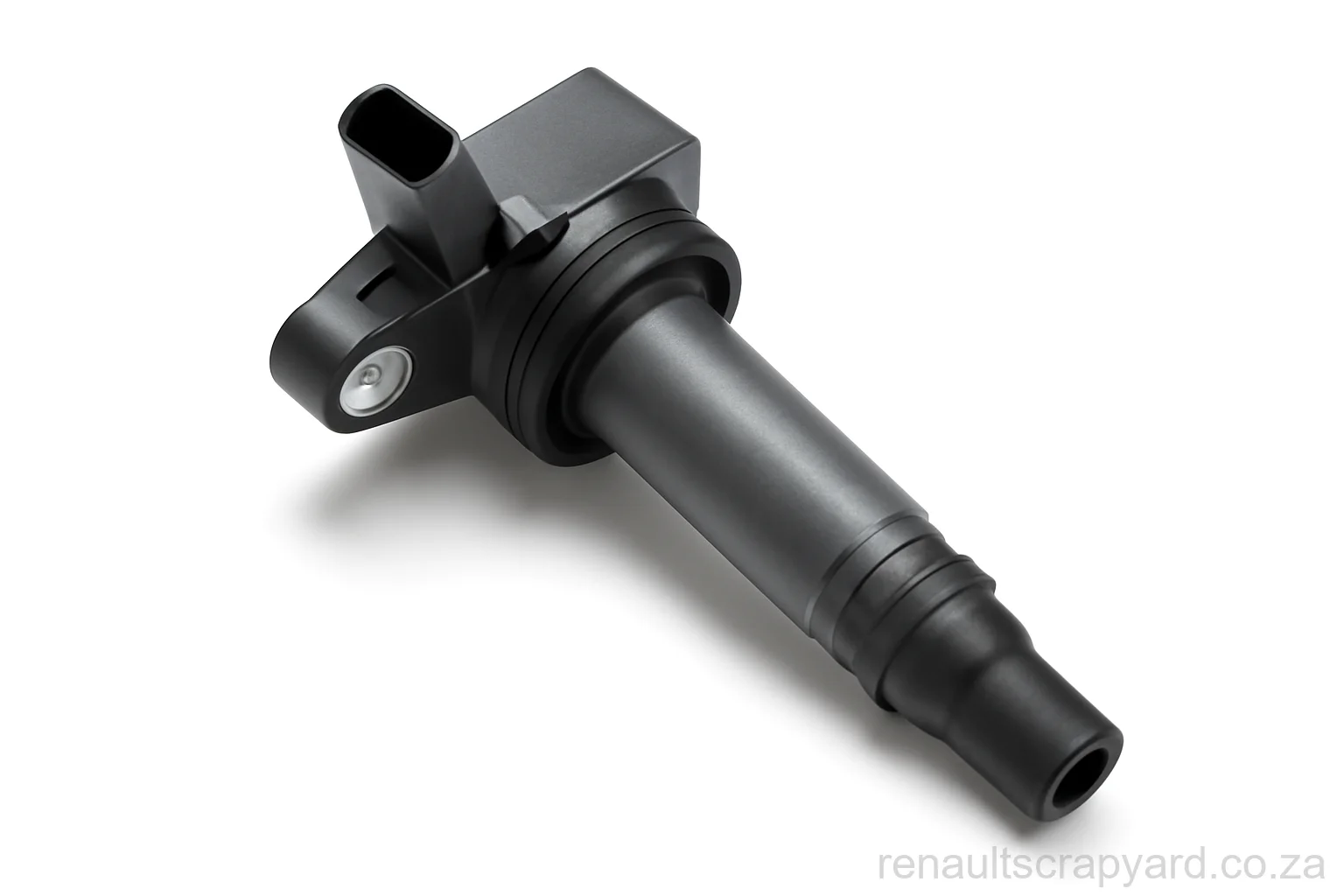
Remove the ignition coil. Unclip the electrical connector, then unbolt the coil (usually one or two 10 mm bolts). Pull it straight up off the spark plug. Label each coil with a piece of tape so you can track which cylinder it came from.
Wipe the terminals. Moisture or oil contamination gives false readings. Use a clean dry cloth.
Set your multimeter to the lowest ohms (Ω) range — typically the 200 Ω setting for the primary test.
Test the primary winding. On a COP-style coil, the primary terminals are the small pins inside the electrical connector recess (where the wiring harness plugs in). Touch the multimeter probes to the two primary pins. A healthy reading is typically 0.4 to 2.0 Ω. If you read 0 Ω (short) or OL/∞ (open), the primary is faulty.
Switch the multimeter to a higher range — 20 kΩ or 200 kΩ — for the secondary test.
Test the secondary winding. Place one probe on the positive primary terminal (same pin used above) and the other probe on the coil's high-voltage output tip — the spring-loaded contact at the base of the coil that presses onto the spark plug. Typical COP secondary resistance is 6,000 to 30,000 Ω. Exact figures vary widely by engine design; consult your FSM for the specification for your engine. Again, 0 Ω or OL means a faulty coil.
Repeat for every coil. On a 4-cylinder engine you have four coils to test; a V6 has six. Compare readings across all coils — one coil reading significantly higher or lower than the others is a red flag even if it's within the general range.
Don't test coils while hot. Resistance values shift with temperature. For the most accurate reading, test cold (engine off for at least 30 minutes). If you're chasing an intermittent misfire that only happens when hot, note that a coil can test fine cold and still break down under heat — a resistance test alone won't catch every fault.
Toyota Ignition Coil Ohm Reference Chart
The table below gives general approximate ranges for different Toyota coil configurations. These are starting points for diagnosis — always verify against the FSM or Denso data sheet for your specific engine and year.
Sources: automotive service literature and Toyota factory forum data. Verify against your specific FSM before replacing a coil based on a borderline reading.
Toyota Ignition Coils
New & quality used stock from our Johannesburg & Cape Town branches — delivered nationwide.
Interpreting Your Readings
Reading
Meaning
Action
Within typical range
Coil resistance is normal
Consider an active/power test or swap to confirm
0 Ω (zero)
Internal short — windings touching
Replace the coil immediately
OL / 1 / ∞
Open circuit — broken winding
Replace the coil immediately
Very high (not OL)
Degraded winding or corrosion
Replace — high resistance starves the spark
One coil significantly different from the others
Likely faulty even if in range
Swap it to another cylinder and see if the misfire follows
The swap test: If a coil reads borderline on the multimeter, move it to a different cylinder and clear codes. If the P030X misfire code follows the coil to its new cylinder, the coil is the problem. This is more definitive than a resistance test alone.
Important Note for Diesel Hilux Owners
The most popular Hilux engines in South Africa — the 3.0 D-4D (1KD-FTV), 2.5 D-4D (2KD-FTV), and 2.8 GD-6 (2GD-FTV) — are diesel engines. Diesel engines ignite fuel through compression, not a spark. They use glow plugs, not spark plugs or ignition coils. If you own one of these, this multimeter test does not apply to your engine.
Ignition coil testing is relevant to petrol Hilux models only: the older 2.7-litre (2TR-FE) and the 4.0-litre V6 (1GR-FE).
SA Replacement Coil Prices (2026)
Once your test confirms a faulty coil, here are indicative ranges to budget for, as listed on our ignition coils page. Remember that on a coil-on-plug engine it's often worth testing all coils at the same time — they age together and a second failure shortly after the first is common.
Indicative ranges only, not quotes; prices vary by condition, mileage, supplier and labour rate
New & quality used stock from our Johannesburg & Cape Town branches — delivered nationwide.
Frequently Asked Questions
Can a coil pass a resistance test and still be bad?
Yes. A resistance test is a static cold test — it checks the windings but cannot detect a coil that breaks down under heat or load. If your readings look fine but you still have a misfire, perform the cylinder-swap test described above, or take the car to a workshop that can do a dynamic ignition test or scope the coil's primary waveform.
What does P0301, P0302, P0303, P0304 mean?
These OBD-II codes point to cylinder-specific misfires: P0301 = cylinder 1, P0302 = cylinder 2, and so on. The code tells you exactly which coil to test first, saving you from pulling all four.
My Toyota Corolla is misfiring on cylinder 2. The coil reads within range. What next?
Swap the cylinder 2 coil with the cylinder 1 coil and clear codes. If the misfire moves to cylinder 1 (P0301), the coil was faulty despite the borderline reading. If the misfire stays on cylinder 2 (P0302), the fault is likely the spark plug, injector, or that cylinder's compression. Read our bad ignition coil symptoms guide for the full diagnostic checklist.
How many ignition coils does a Toyota Corolla have?
The Corolla's 4-cylinder engine has four ignition coils — one per cylinder. They sit directly on top of the spark plugs and are accessed by removing the engine cover. If one fails, check the others for wear at the same time. See our full Toyota Corolla parts page for all Corolla ignition components.
Can I test an ignition coil without removing it?
You can probe the primary circuit through the wiring connector with the coil still installed, but you won't be able to reach the secondary output terminal without removing the coil from the spark plug. It's quicker and safer to remove the coil for a proper two-winding test.
What ohm range is normal for a Toyota coil?
Primary resistance typically falls between 0.4 and 2.0 Ω; secondary resistance on a coil-on-plug unit typically falls between 8,000 and 30,000 Ω, though exact values vary by engine. Always verify against the FSM for your specific engine — a reading that's fine for one engine may be out of spec for another. Once you've diagnosed and confirmed a faulty coil, check the Toyota ignition coil price guide to budget for the replacement.
Related Video
Video: Testing Toyota's Four Wire Ignition Coils The Low Tech Way
This article is for informational and educational purposes only, based on automotive industry research and publicly available data. Used Toyota Parts SA is a parts supplier, not a licensed automotive repair facility. We do not provide mechanical advice or diagnostics.
Always consult a qualified mechanic or Toyota-certified technician before performing repairs. Incorrect installation of parts can lead to vehicle damage, safety hazards, or injury. Prices, specifications, and availability mentioned are approximate and subject to change.
We assume no liability for actions taken based on this content. Contact us for current parts availability and pricing.
Need Toyota Parts?
Get a free quote from our suppliers. New aftermarket and quality used parts for all 37 Toyota models, delivered nationwide.