Try searching for something else or browse our categories.
Ignition SystemBuyer's Guides
Coil Pack vs Ignition Coil — What's the Difference?
Confused about coil packs vs ignition coils on your Toyota? Plain-English SA guide covers the 3 ignition types, which Toyota uses which, and 2026 replacement costs.
Craig Sandeman
Automotive industry researcher and content specialist at Used Toyota Parts SA.
A coil pack is a type of ignition coil that fires two cylinders from one housing — but most modern Toyotas use coil-on-plug (one coil per cylinder) instead. Knowing which system your car has tells you exactly how many coils to buy and what you'll pay.
Key Takeaways
Walk into any parts shop and ask for an “ignition coil” for your Toyota Corolla, and you might be handed something completely different to what your neighbour got for his older Tazz. One car needs four individual pencil-type coils; the other needs just one coil that mounts near the distributor. Both are ignition coils — but they work in very different ways.
This guide cuts through the confusion. We explain the three ignition system designs Toyota has used over the years, which models have which, and what it means for your wallet when something goes wrong.
Key Takeaways
System Type
How It Works
Common Toyota Models
Coils to Replace
Distributor Coil
One coil, mechanical distributor routes spark to each plug
Tazz, Corolla pre-2003 (4A-FE, 7A-FE)
1 coil
Coil Pack (Wasted Spark)
One coil housing fires two cylinders simultaneously
Some late-1990s 4-cylinder models
1–2 coil packs
Coil-on-Plug (COP)
One coil sits directly on each spark plug — no HT wires
Corolla 2007+, Hilux 2.7, Fortuner 2.7
1–4 coils (one per cylinder)
What All Ignition Coils Have in Common
Every ignition coil — regardless of type — does the same fundamental job: it transforms the low 12-volt current from your battery into a high-voltage spark (tens of thousands of volts) strong enough to ignite the compressed air-fuel mixture in the combustion chamber. Without that voltage boost, your spark plug cannot fire.
The difference between a “coil pack” and a “coil-on-plug” is not what the coil does — it is where it sits and how many cylinders it serves.
Quick definition: Every coil pack is a type of ignition coil, but not every ignition coil is a coil pack. “Ignition coil” is the broad category; coil pack and coil-on-plug are sub-types within it.
The Three Toyota Ignition System Types
1. Distributor Coil (Single External Coil)
This is the oldest design and what you’ll find on Toyotas made before roughly the year 2000. A single cylindrical coil produces high-voltage current. A mechanical distributor then rotates, physically routing that spark to each cylinder in sequence via high-tension (HT) plug wires.
Failure consequence: If the single coil fails, ALL cylinders stop firing and the engine dies completely. Diagnosis is straightforward — no spark anywhere — but a rough idle or stumble can also point to the distributor cap or HT leads before the coil itself.
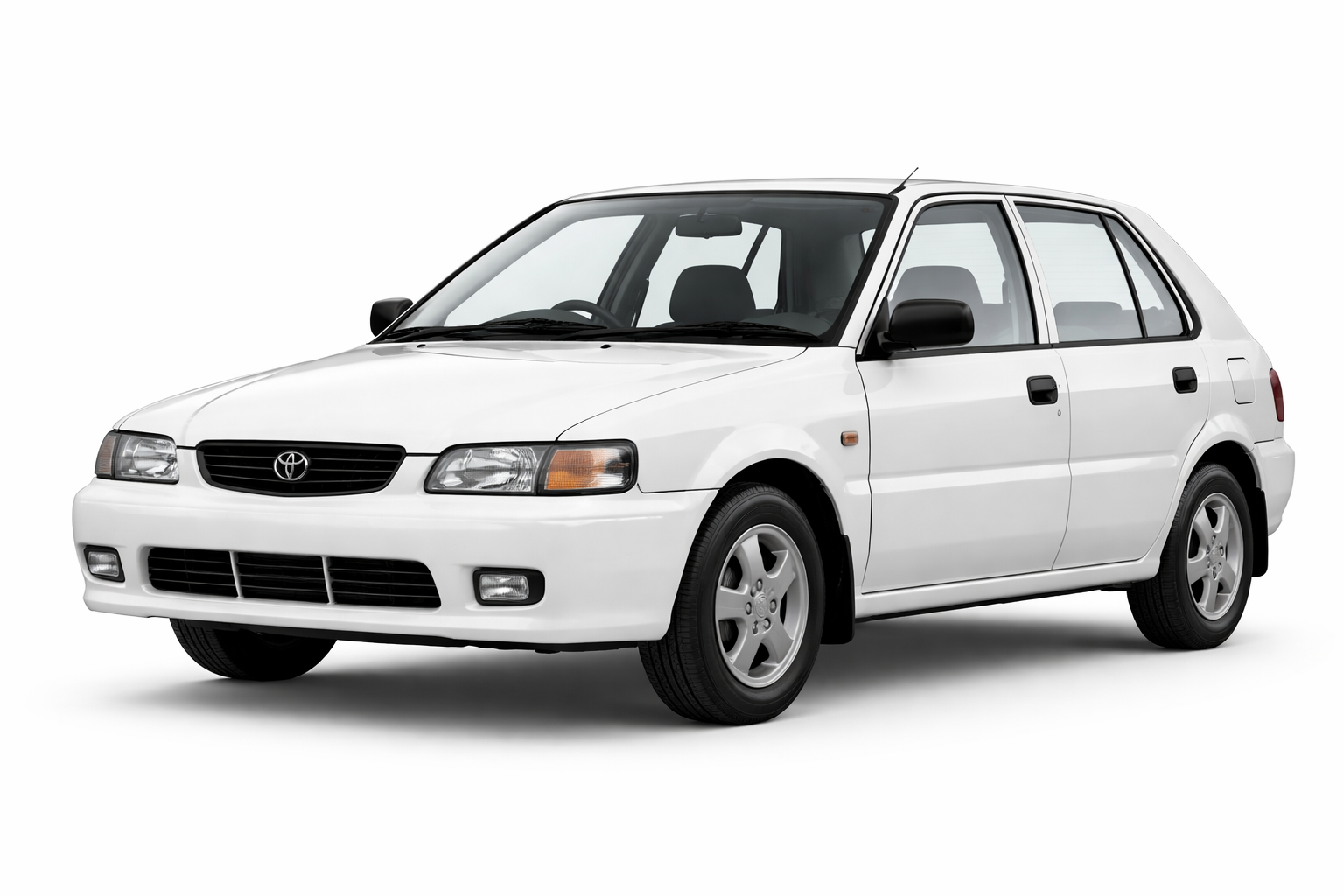
Toyota models using this system: Tazz (all variants), Corolla AE101/AE102 with 4A-FE and 7A-FE engines, and many older Hilux petrol models from the 1990s.
2. Coil Pack — The Wasted-Spark System
The coil pack — also called a wasted-spark or Distributorless Ignition System (DIS) — replaced the mechanical distributor during the mid-to-late 1990s. Instead of one coil serving all cylinders through a rotor, the coil pack groups multiple coils into a single plastic housing and uses electronics to fire them.
Each coil inside the pack fires two spark plugs simultaneously via short HT leads: one plug in a cylinder on its compression stroke (doing real work) and one in a paired cylinder on its exhaust stroke (the “wasted” spark). The exhaust-stroke plug fires harmlessly into spent gases.
A 4-cylinder engine needs just 2 coils in a wasted-spark pack (2 coils × 2 cylinders each = 4 plugs). A 6-cylinder needs 3 coils.
Failure consequence: When one coil inside the pack fails, both the cylinders it serves misfire together — producing two paired misfire codes at once. This paired-failure pattern (two codes from the same coil’s cylinder pair) is a classic coil-pack diagnostic clue.
3. Coil-on-Plug (COP) — Toyota’s Modern Standard
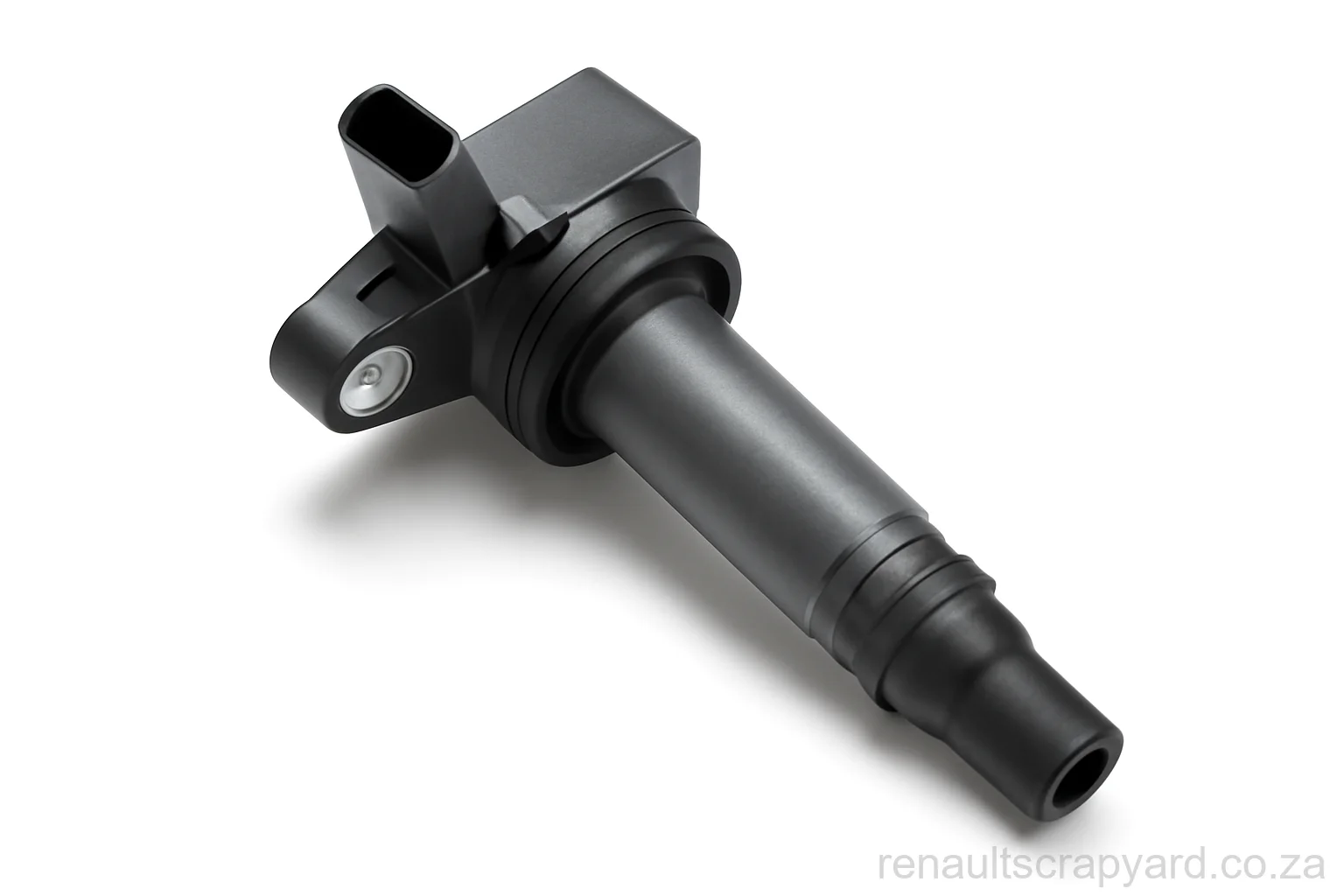
From roughly 2003 onwards, Toyota moved most of its petrol models to coil-on-plug (COP) ignition. In a COP system, each spark plug has its own dedicated ignition coil mounted directly on top of it, slotted into the camshaft cover. There are no HT wires and no distributor — just a neat pencil-shaped coil plugged straight onto the plug.
The ECU fires each coil independently, giving precise timing control per cylinder and making fault diagnosis much simpler: a single cylinder misfire code (P0301, P0302, etc.) tells you exactly which coil to check.
Toyota Ignition Coil (Coil-on-Plug)
New & quality used stock from our Johannesburg & Cape Town branches — delivered nationwide.
COP advantage: Because each coil fails independently, you can often replace just the one bad coil. On high-mileage vehicles (150,000 km+), many mechanics recommend replacing the full set of 4 at once while the coils are already out — it saves a second visit when the next one goes.
Which Ignition System Does My Toyota Use?
The table below covers the most common petrol-engine Toyotas on South African roads. Diesel models (Hilux 2.4 GD6, Hilux 2.8 GD6, Fortuner 2.8) do not use ignition coils at all — diesel engines rely on compression ignition and use glow plugs for cold-start assistance instead.
Toyota Model
Engine
System
Coils per Vehicle
Tazz 1.3 / 1.6
2E / 4A-FE
Distributor (single coil)
1
Corolla AE101/AE102 1.6 / 1.8
4A-FE / 7A-FE
Distributor (single coil)
1
Corolla 1.6 Professional (2007–2013)
1ZR-FE
Coil-on-Plug
4
Corolla 1.8 (2013 onwards)
2ZR-FE / 2ZR-FAE
Coil-on-Plug
4
Hilux 2.7 Petrol / Fortuner 2.7
2TR-FE
Coil-on-Plug
4
Hilux 2.4 / 2.8 Diesel
2GD-FTV / 1GD-FTV
N/A — uses glow plugs
0
Not sure which engine you have? Check the sticker on your engine bay strut tower or the vehicle’s service book. Alternatively, browse our Toyota ignition coils page and select your model to find the right coil for your exact model and year.
What Does It Cost to Replace in South Africa? (2026 Prices)
The cost difference between the three system types is significant. A single distributor coil for an older Corolla or Tazz costs far less than a full COP set for a modern Hilux 2.7 — but on the COP models you may only need to replace one faulty coil at a time.
Indicative ranges only, not quotes; prices vary by condition, mileage, supplier and labour rate
System / Model
Part Cost Per Coil
Full Set Cost (Parts Only)
Corolla 1ZR-FE / 2ZR-FE (COP, aftermarket to genuine Denso)
R495 – R900 each
R1,980 – R3,600 (set of 4)
Hilux 2.7 / Fortuner 2.7 (COP, aftermarket to genuine Denso)
New & quality used stock from our Johannesburg & Cape Town branches — delivered nationwide.
Does It Matter Which Brand You Buy?
Yes — and the answer differs by system type. Older distributor coils from reputable aftermarket brands (NGK, Bosch, Mobiletron) are generally interchangeable and widely available. For COP systems, the quality gap between brands widens: Toyota’s OEM supplier is Denso, and their coils are engineered precisely for Toyota’s ignition timing demands. Budget no-name COP coils can deliver a weaker or inconsistent spark, which shows up as misfires, lost power and poorer fuel economy.
Recognising a Failed Coil by System Type
The misfire pattern you experience gives a clue about which ignition system has failed:
Distributor coil failed: Complete no-start or engine cuts out entirely. No spark at any plug.
Coil pack failed: Rough idle and loss of power; two paired misfire codes appear together. The ECU flags both because one coil fires both paired cylinders.
COP coil failed: Misfire and check-engine light; a single misfire code (P0301, P0302, etc.) for one specific cylinder. The engine runs rough but still starts.
Quick self-test: On a COP system, swap the suspect coil with one from an adjacent cylinder and clear the codes. If the misfire code moves to the new cylinder, the coil is faulty. If it stays on the original cylinder, the spark plug or fuel injector is the more likely culprit.
Frequently Asked Questions
Is a coil pack the same as an ignition coil?
Not exactly. A coil pack is a specific type of ignition coil assembly that groups multiple coils in one housing and fires pairs of cylinders at once (wasted-spark design). “Ignition coil” is the broad term covering all three types: distributor coil, coil pack, and coil-on-plug. So all coil packs are ignition coils, but not all ignition coils are coil packs.
How do I know if my Toyota has a coil pack or coil-on-plug?
Open the bonnet and look at the top of the engine. If you see individual pencil-shaped coils sitting in wells on the camshaft cover — one over each cylinder — you have coil-on-plug. If you see a single plastic block with multiple HT leads running from it to the spark plugs, that is a coil pack. If you see one round coil connected to a cap with four or more leads going to each plug, that is a distributor setup.
Can I replace just one coil, or do I need to replace all of them?
On a COP system you can replace just the failed coil. However, if your vehicle has high mileage and one coil has already failed, the others have lived equally long — replacing the full set while the coils are already out saves on future labour. On a coil pack system, the whole pack is usually replaced as a unit.
What happens if I drive with a failed ignition coil?
On a COP system, a single failed coil means the engine runs on three cylinders. Raw fuel enters that cylinder, passes through the catalytic converter, and can overheat and damage it quickly. It also increases fuel consumption and causes vibration. Stop driving and get it fixed promptly. For more detail, read our guide: can you drive with a bad ignition coil?
My Toyota Hilux diesel has no ignition coils. Is that normal?
Yes, completely normal. Diesel engines use compression ignition — the fuel ignites from the heat generated by compressing air — so they do not need spark plugs or ignition coils. They use glow plugs instead to assist cold starting. This applies to the Hilux 2.4 (2GD-FTV) and Hilux/Fortuner 2.8 (1GD-FTV) diesel engines.
Related Video
Video: Learn Everything About Ignition Coils, Coil Packs and Coil-Over-Plugs
This article is for informational and educational purposes only, based on automotive industry research and publicly available data. Used Toyota Parts SA is a parts supplier, not a licensed automotive repair facility. We do not provide mechanical advice or diagnostics.
Always consult a qualified mechanic or Toyota-certified technician before performing repairs. Incorrect installation of parts can lead to vehicle damage, safety hazards, or injury. Prices, specifications, and availability mentioned are approximate and subject to change.
We assume no liability for actions taken based on this content. Contact us for current parts availability and pricing.
Need Toyota Parts?
Get a free quote from our suppliers. New aftermarket and quality used parts for all 37 Toyota models, delivered nationwide.