



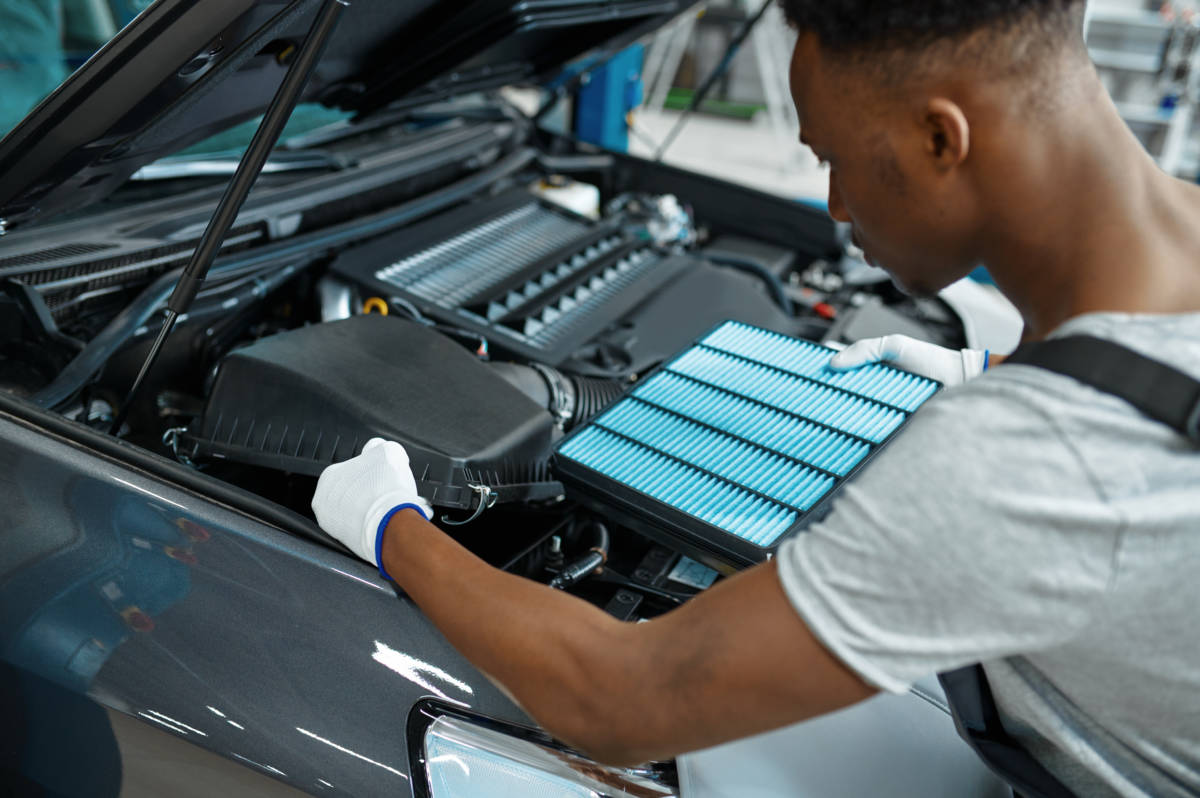

Your Toyota’s engine air filter is a pleated barrier that prevents dust, sand, insects, and debris from entering the combustion chambers where they would grind against cylinder walls and destroy internal components. I recommend replacing it every 15,000 to 30,000 km under normal driving conditions, or every 10,000 km if you regularly drive on gravel or dusty roads — a reality for a significant portion of South African motorists. A genuine Toyota air filter costs between R150 and R500 depending on your model, and changing it takes less than ten minutes. Neglecting this one filter can cost you up to 10% of your engine power and accelerate wear on components that cost tens of thousands of rands to replace.
Key Takeaways
| Topic | Key Finding | Jump To |
|---|---|---|
| What It Does | Filters airborne particles down to 5-10 microns before they enter the combustion chamber | What Does an Air Filter Do |
| Filter Types | Paper (standard), cotton gauze (reusable), and foam (pre-filter) each serve different purposes | Types of Air Filters |
| Change Interval | Every 15,000-30,000 km in normal conditions; every 10,000 km in dusty or severe conditions | When to Replace It |
| Dusty Roads Impact | Gravel and dirt roads can clog a filter in half the normal interval or less | Dusty Roads and Gravel |
| Warning Signs | Sluggish acceleration, reduced fuel economy, black exhaust smoke, rough idle | Signs of a Clogged Filter |
| Cost in ZAR | R150-R500 for the filter; R300-R800 fitted at a workshop | Air Filter Costs |
| Clean and Reuse? | Paper filters cannot be effectively cleaned; oiled cotton filters can be washed and re-oiled | Can You Clean and Reuse |
What Does an Air Filter Do
Your engine is essentially a giant air pump. For every litre of fuel it burns, it needs approximately 10,000 litres of air. That air enters through the intake, passes through the air filter, flows past the mass airflow sensor, into the throttle body, and finally into the combustion chambers where it mixes with fuel and ignites. The air filter sits right at the front of this chain, and its job is to catch every particle of dust, sand, pollen, and debris before it reaches the engine’s internals.
Without an air filter, abrasive particles as small as 10 microns — invisible to the naked eye — would enter the combustion chamber and score the cylinder walls, damage piston rings, contaminate engine oil, and accelerate wear on every moving surface. A quality air filter traps 99% of airborne contaminants while still allowing sufficient airflow for efficient combustion.
I find it useful to understand the three core functions an air filter performs:
- Particle filtration: Captures dust, sand, pollen, insects, and road debris ranging from 5 to 100+ microns in size
- Airflow management: Allows a high volume of clean air to pass through with minimal restriction, maintaining the correct air-to-fuel ratio
- Engine protection: Acts as the first line of defence for precision-machined components including cylinder bores, piston rings, valve seats, and the turbocharger (on diesel models like the Hilux 2.4 and 2.8 GD-6)
How Much Air Your Engine Processes
A Toyota Hilux 2.8 GD-6 diesel engine processes roughly 300 to 500 litres of air per minute at highway speed. Over a 10,000 km service interval, that equates to millions of litres of air passing through the filter. Every grain of sand the filter catches is one fewer abrasive particle wearing down your engine.
A study published in Petroleum Science and Technology tested the effects of a progressively clogged air filter on a diesel engine and found measurable drops in both power and torque. At full clog, maximum power dropped from 64.2 kW to 58.1 kW — a loss of nearly 10% — while fuel consumption nearly doubled. That study examined an extreme scenario, but the principle applies to any engine: the dirtier the filter, the harder the engine works and the less efficiently it runs.
If you are sourcing replacement parts for your Toyota Hilux or Fortuner, the air filter should be near the top of your routine service checklist alongside oil and oil filter changes.
Types of Air Filters
Not all air filters are made equal. The material, design, and construction of the filter element determine how well it traps particles, how much airflow it allows, and how long it lasts. Here are the three main types you will encounter for Toyota vehicles:
Paper (Cellulose) Filters
Paper filters are standard equipment on every Toyota sold in South Africa. They use pleated cellulose fibre media — essentially a specially engineered paper — folded into accordion-style pleats to maximise surface area within a compact housing.
Pros:
- Excellent filtration efficiency (captures 99%+ of particles down to 5-10 microns)
- Inexpensive (R150-R400 for genuine Toyota)
- Proven reliability across billions of kilometres of real-world use
- No maintenance required — simply replace at the service interval
Cons:
- Single-use; cannot be cleaned and reused effectively
- Airflow restriction increases progressively as the filter loads with dust
- Shorter lifespan in dusty conditions
For the vast majority of Corolla, Etios, and Starlet owners who drive primarily on paved roads, a quality paper filter changed on schedule is the best option.
Cotton Gauze (Oiled) Filters
Cotton gauze filters, popularised by brands like K&N and BMC, use multiple layers of oiled cotton fabric instead of paper. The oil coating helps trap fine particles while the open weave structure allows higher airflow than paper.
Pros:
- Reusable — can be cleaned, re-oiled, and reinstalled
- Higher airflow than paper (typically 1-3% improvement in naturally aspirated engines)
- Long-term cost savings since one filter can last the life of the vehicle with proper maintenance
- Better for high-dust environments where frequent paper filter replacement gets expensive
Cons:
- Higher upfront cost (R700-R1,500)
- Requires proper cleaning and re-oiling every 10,000-15,000 km
- Slightly lower filtration efficiency than paper on the finest particles
- Over-oiling can contaminate the mass airflow sensor
OEM Paper vs Cotton Gauze: My Verdict
For daily driving and standard commuting, stick with OEM paper filters. The filtration efficiency is superior, the cost is low, and there is zero maintenance. For Hilux and Fortuner owners who spend serious time on gravel roads and trails, a quality cotton gauze filter can be a practical choice because you can clean it trailside rather than needing a replacement. Just be disciplined about the cleaning schedule.
Foam Filters
Foam filters use open-cell polyurethane foam, often oiled, as the filtration medium. They are rarely used as primary air filters on road-going Toyotas but appear frequently as pre-filters or dust covers that wrap around the main air filter element.
Pros:
- Excellent at capturing large particles and heavy dust
- Washable and reusable
- Effective as a pre-filter to extend the life of the main filter
Cons:
- Lower filtration efficiency on fine particles compared to paper or cotton
- Not suitable as a standalone primary filter for modern fuel-injected engines
Some aftermarket suppliers offer foam pre-filter wraps for the Hilux and Fortuner air filter housings. These can be useful in extremely dusty conditions, adding an extra layer of protection before air reaches the main filter element.
When to Replace Your Toyota’s Air Filter
Toyota’s official maintenance schedules and independent research converge on a consistent set of replacement intervals. After reviewing owner’s manuals, service bulletins, and data from FRAM and Cars.com, here is what I recommend for each popular Toyota model in South Africa:
| Model | Engine | Normal Interval | Severe/Dusty Interval |
|---|---|---|---|
| Hilux 2.4 GD-6 | 2GD-FTV Diesel | 30,000 km | 10,000-15,000 km |
| Hilux 2.8 GD-6 | 1GD-FTV Diesel | 30,000 km | 10,000-15,000 km |
| Fortuner 2.4/2.8 GD-6 | Diesel | 30,000 km | 10,000-15,000 km |
| Corolla 1.8 | 2ZR-FE Petrol | 30,000 km | 15,000 km |
| Corolla 2.0 | M20A-FKS Petrol | 30,000 km | 15,000 km |
| Etios 1.5 | 2NR-FE Petrol | 20,000 km | 10,000 km |
| Starlet 1.5 | 2NR-FE Petrol | 20,000 km | 10,000 km |
| Quantum 2.5 D-4D | 2KD-FTV Diesel | 20,000 km | 10,000 km |
Most South African Driving Qualifies as “Severe”
Toyota defines severe driving conditions as: frequent dusty or gravel roads, stop-and-go traffic in high-pollution areas, towing, and frequent short trips. If you live in Gauteng with its construction dust and congestion, drive farm roads in the Free State, or navigate the unpaved routes of Limpopo or the Eastern Cape, your driving conditions are severe. Use the shorter interval.
The U.S. Department of Energy’s Oak Ridge National Laboratory tested three vehicles, including a 2003 Toyota Camry, and found that a clogged air filter improved acceleration times by 6-11% once replaced. The Camry specifically showed a 7% improvement in 20-80 mph acceleration (1.26 seconds faster) after fitting a clean filter. For modern fuel-injected engines, the study found that engine management systems compensate for reduced airflow to maintain the air-to-fuel ratio, so fuel economy does not suffer as dramatically as power does. But that compensation comes at the cost of reduced performance and increased strain on the engine.
The practical rule I follow: check the filter visually at every oil change and replace it at least every 20,000 km, regardless of what the service schedule says. If it looks dirty, it is dirty. Replace it.
Dusty Roads and Gravel: Why South African Conditions Require More Frequent Changes
South Africa has approximately 600,000 km of gravel and unpaved roads, compared to roughly 160,000 km of paved roads. If you drive a Hilux or Fortuner — and statistically, there is a very good chance you do — you are probably spending some portion of your driving time on surfaces that throw up clouds of fine dust with every passing vehicle.
This dust is the enemy of air filters. Gravel road dust consists of ultra-fine silica particles that are extraordinarily abrasive. These particles are small enough to pass through a damaged or saturated filter and hard enough to score hardened steel cylinder walls. A single trip on a heavily trafficked dirt road can deposit more dust on your air filter than a month of highway driving on tar.
The Dust Factor on Gravel Roads
According to Premium Guard Filters, driving on unpaved roads exposes the filter to vastly more particulate matter than paved surfaces. In extreme dust conditions — such as following a truck convoy on a Limpopo gravel road — a filter can become visibly loaded in as little as 2,000 to 5,000 km. Drivers in these environments should inspect their air filter at least monthly.
Here is what happens when dust overwhelms your air filter:
- Progressive restriction: As dust accumulates in the filter pleats, airflow decreases. The engine’s ECU compensates by reducing fuel delivery, which means less power.
- Turbocharger vulnerability: On turbodiesel models like the Hilux 2.4 and 2.8 GD-6, restricted airflow forces the turbo to work harder to build boost, increasing exhaust gas temperatures and accelerating turbo bearing wear.
- Filter bypass: If the filter becomes severely clogged, air can be drawn around the filter seal rather than through it, allowing unfiltered air directly into the intake. This defeats the entire purpose of the filter.
- Accelerated engine wear: Once abrasive particles enter the combustion chamber, they mix with engine oil, creating a grinding paste that accelerates wear on every moving component.
My Recommendations for Gravel Road Drivers
- Inspect the air filter every 5,000 km if you drive on gravel regularly
- Replace every 10,000 km maximum on heavily used dirt roads
- Consider a pre-filter or snorkel for vehicles that spend extended time off-road; a snorkel raises the air intake above the worst of the dust cloud
- Check the air filter housing seal regularly — cracked or brittle seals allow unfiltered air into the intake
- Carry a spare air filter on extended gravel road trips through remote areas
For Hilux engine parts and Fortuner engine parts, having a fresh air filter on hand is cheap insurance against expensive engine damage.
Signs of a Clogged Air Filter
Your Toyota will show several symptoms when the air filter is restricting airflow. Some are obvious, others are subtle enough that many owners miss them entirely. Based on my research across technical sources and workshop data, here are the most reliable indicators:
1. Reduced Acceleration and Power Loss
This is the most common symptom. A clogged air filter starves the engine of air, and modern engine management systems respond by reducing fuel delivery to maintain the correct air-to-fuel ratio. The result is noticeably sluggish acceleration, particularly under load — such as pulling away uphill or overtaking on the highway.
The DOE study found acceleration improvements of 6-11% simply by replacing a clogged filter. If your Corolla feels flat or your Hilux is struggling to pull under load, check the air filter before you spend money on diagnostics.
2. Increased Fuel Consumption
While modern fuel-injected engines compensate better than older carburetted engines, a severely restricted air filter still increases fuel consumption. The engine works harder to draw air through a clogged filter, and the overall combustion efficiency drops. An increase of 5-10% in fuel consumption is common with a heavily loaded filter.
The Hidden Cost of a Dirty Air Filter
A 5-10% increase in fuel consumption on a Hilux 2.8 GD-6 averaging 9 L/100 km translates to an extra 0.5-0.9 litres per 100 km. At R24/litre for diesel, that is an extra R120-R216 per 1,000 km driven. A replacement air filter at R250-R400 pays for itself within 2,000-3,000 km of driving.
3. Unusual Engine Sounds
When airflow is restricted, you may hear a coughing or sputtering sound from the engine, particularly during acceleration. Some owners describe a wheezing or sucking noise from the air intake area. This is the engine literally struggling to breathe.
4. Black Exhaust Smoke
A rich-running condition caused by insufficient air relative to fuel can produce dark or black exhaust smoke, particularly on diesel models. If your Fortuner or Quantum is pushing out more visible exhaust than usual, the air filter is a prime suspect alongside injector issues.
5. Check Engine Light
In severe cases, the engine control unit detects abnormal airflow readings from the mass airflow sensor and triggers the check engine light. Fault codes related to lean or rich running conditions, airflow sensor readings, or intake restrictions can all point back to a clogged air filter.
6. Rough Idle
Inconsistent airflow from a partially clogged filter can cause the engine to idle unevenly. You may notice slight vibrations or RPM fluctuations at idle that disappear when you rev the engine.
The 30-Second Visual Check
Pop the bonnet, unclip the air filter housing, and hold the filter up to sunlight. If you can see light through the pleats, the filter still has life. If the pleats are packed solid with dust and no light passes through, replace it immediately. This takes less time than reading this paragraph.
Air Filter Costs for Popular Toyota Models
Air filters are among the cheapest maintenance items on any Toyota. I have compiled current pricing for genuine and quality aftermarket options across the most popular models in South Africa:
| Model | Genuine Part No. | Genuine Price (ZAR) | Aftermarket (Ryco/Wix) | Budget Aftermarket |
|---|---|---|---|---|
| Hilux 2.4/2.8 GD-6 | 17801-0L040 | R350-R500 | R200-R350 | R100-R180 |
| Fortuner 2.4/2.8 GD-6 | 17801-0L040 | R350-R500 | R200-R350 | R100-R180 |
| Corolla 1.8/2.0 | 17801-21050 | R200-R350 | R150-R250 | R80-R150 |
| Etios 1.5 | 17801-21050 | R180-R300 | R120-R220 | R70-R130 |
| Starlet 1.5 | 17801-21050 | R180-R300 | R120-R220 | R70-R130 |
| Quantum 2.5 D-4D | 17801-0C010 | R300-R450 | R180-R300 | R90-R160 |
| Hilux 2.7 VVTi (Petrol) | 17801-0C010 | R300-R400 | R180-R280 | R90-R150 |
Workshop vs DIY Cost
| Service Type | DIY Cost (ZAR) | Workshop Cost (ZAR) |
|---|---|---|
| Air filter only (petrol models) | R150-R350 | R300-R600 |
| Air filter only (diesel models) | R200-R500 | R400-R800 |
| Air filter + cabin filter combo | R350-R750 | R600-R1,200 |
| K&N reusable filter (one-time purchase) | R700-R1,500 | R900-R1,800 |
Annual Air Filter Costs: Paper vs Reusable
A paper filter replaced every 15,000 km costs roughly R300-R500 per change. If you drive 30,000 km per year, that is R600-R1,000 annually. A K&N reusable filter costs R700-R1,500 upfront but only needs a R150 cleaning kit every 15,000 km. Over five years, the K&N saves approximately R1,000-R2,500 — more if you drive on gravel roads and change filters more frequently.
Replacing the air filter yourself is one of the easiest DIY maintenance tasks on any Toyota. On most models, the air filter housing is located on top of the engine with simple spring clips or screws holding the lid in place. No tools are required on many petrol models. For a visual walkthrough, watch the 1A Auto guide linked above on replacing the engine air filter on a Toyota Corolla.
Can You Clean and Reuse an Air Filter
This is one of the most common questions I encounter, and the answer depends entirely on what type of filter you have.
Paper Filters: No
Standard paper (cellulose) air filters cannot be effectively cleaned and should always be replaced. According to testing reviewed by Smart Air, using compressed air on a paper filter actually makes it less effective at trapping particles. The high-pressure air blows microscopic holes in the filter media, creating pathways for dust to pass straight through to the engine. The damage is invisible to the naked eye but measurable in filtration testing.
Here is what does not work on paper filters:
- Compressed air: Damages filter media fibres, creating invisible holes that allow dust through
- Tapping the filter: Removes large surface debris but does nothing for the fine particles embedded deep in the media
- Vacuuming: Removes surface dust but cannot clean the inner layers where most filtration occurs
- Washing with water: Destroys the filter media entirely and compromises the structural integrity
Never Reuse a Paper Air Filter
A new paper air filter costs R150-R400. The engine it protects costs R30,000-R120,000 to replace. Trying to save R200 by blowing out an old filter and reinstalling it is a false economy that risks allowing abrasive particles into your engine. Replace it with a new filter every time.
Cotton Gauze Filters: Yes, with Proper Maintenance
Reusable cotton gauze filters from brands like K&N and BMC are designed to be cleaned and re-oiled. The process requires a specific cleaning kit and takes approximately 30 minutes plus drying time:
- Apply cleaning solution to both sides of the filter and let it soak for 10 minutes
- Rinse from the clean side out with low-pressure water (never use a high-pressure hose)
- Allow to air dry completely — this takes 12-24 hours depending on conditions; never use compressed air or a heat source to speed drying
- Apply filter oil evenly across the intake side of the filter using the supplied spray or squeeze bottle
- Allow the oil to wick through the media for 20 minutes before installing
The critical point is to never use compressed air on a cotton gauze filter either. While these filters are more durable than paper, compressed air can still deform the cotton fibres and reduce filtration efficiency. Let gravity and air do the drying.
Foam Pre-Filters: Yes
Foam pre-filter wraps can be washed in warm soapy water, rinsed, dried thoroughly, and lightly re-oiled before reinstallation. These are the most forgiving filter type when it comes to cleaning and reuse.
My Practical Recommendation
For most Toyota owners, the simplest and most reliable approach is a quality paper filter changed on schedule. The cost is minimal, the protection is excellent, and there is no risk of improper cleaning compromising filtration. If you drive extensively on gravel roads and want the convenience of cleaning rather than replacing, a K&N or BMC cotton gauze filter is a sound investment — just follow the cleaning procedure exactly as specified.
The bottom line: your Toyota’s air filter is a R200-R500 component that stands between your engine and every grain of sand, dust particle, and piece of road debris on South African roads. Change it every 15,000-30,000 km on tar, every 10,000 km on gravel, and always inspect it visually at each oil change. Whether you drive a Hilux, Fortuner, Corolla, Etios, or Starlet, a fresh air filter is the cheapest insurance you can buy for your engine. If you are looking for Hilux engine parts or Fortuner engine parts, start with the air filter and work your way down the service list from there.